Today we are going to cover an interestingtechnique used by the masters which is also used by artists today. This is a technique that will create a window of depth. Sometimes created naturally, but if you know how to look for it, and how it affects the viewers eyes, then you will be able to harness it at will and incorporate it into your art. Let’s get started!
This technique of creating a window of depth can also refer to the article on mirrors (see Day 238), and how they create depth.
I first noticed this technique in Bouguereau‘s painting below as I was writing the article on edge flicker (see Day 49). I was curious as to why he left the light area in the forest. It’s a light area surrounded by dark which creates a high contrast point…drawing our eyes away from the subject…right? Well, yes and no. Yes, he’s using it to pull our eyes away from the subject, but this is a tool and not a flaw. They viewers eyes travel from the face, down the body and leg, through the forest to the light, then back again. He’s adding visual depth on a 2D surface with just one little tiny stroke of paint.
Here’s the painting adjusted just by taking out that lightest area in the trees. Can you see how the depth is affected?
How about now when I edit out the other light areas in the forest? The depth is affected dramatically. It’s still an amazing painting, but the effect of depth he achieved is no longer visible.
In order for it to be perceived as depth it has to be higher in the frame than the subject. This tells our mind that it is receding into the distance. And if it’s a window or door, it should present hints of what lies beyond it. If it’s a forest scene, then light is sufficient
Not Quite
In order to understand a bit further, let’s take a look at some amazing pieces of art that are great just as they are, but aren’t using the technique in which I’m referring to in this article.
In this first one we see the light coming through the trees, but since the contrast near the light areas isn’t that great it doesn’t give us the same effect as it did in Bouguereau’s painting.
Photo by Alexandre Sophie.
In order to achieve this window of depth, we should have a high contrast area which is surrounded by darks. The amount of lightness would depend on the scene and your judgment. You don’t want the viewer’s eyes going first to something that should be secondary. Always remember your visual hierarchy and the effects of simultaneous contrast (see Day 28) has on our eyes.
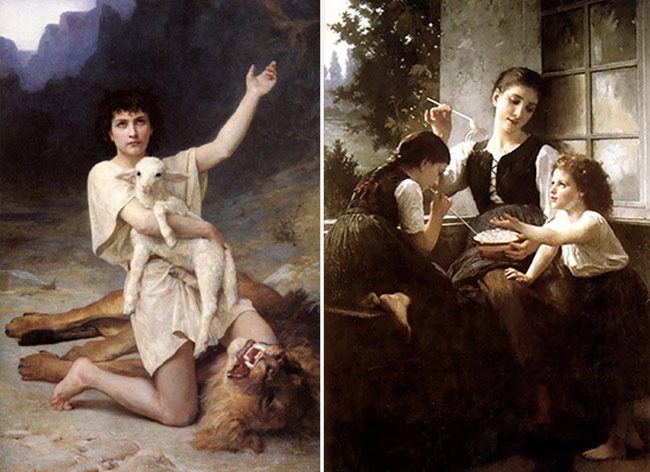
So, below we have a couple more Bouguereau’s paintings. Both very nice, but using different techniques. In these, he’s using aerial perspective (see Day 42) to add depth. This means he’s reducing the contrast of the background, not increasing the contrast and surrounding it with darks like he did in the first one.
Paintings by Bouguereau.
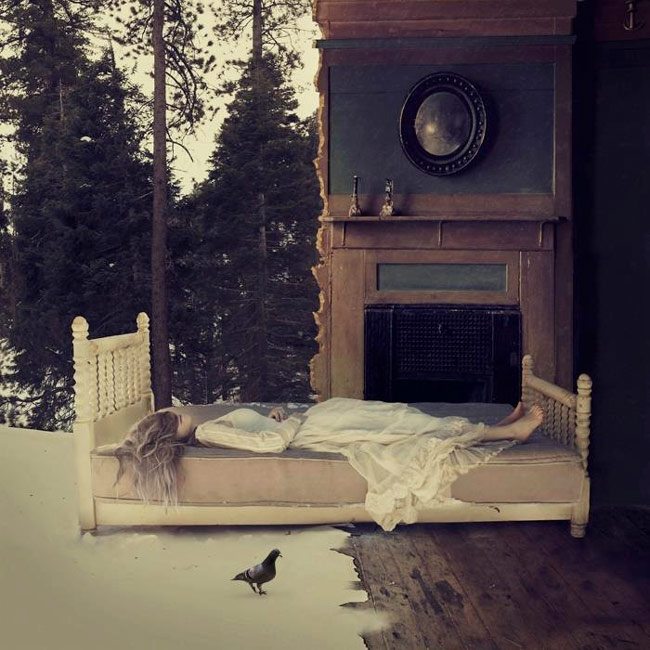
Here’s a great photo, but again, this depth is different because it’s not a path that the eyes can travel through. It travels to the tree line, but not through. Are you starting to get it?
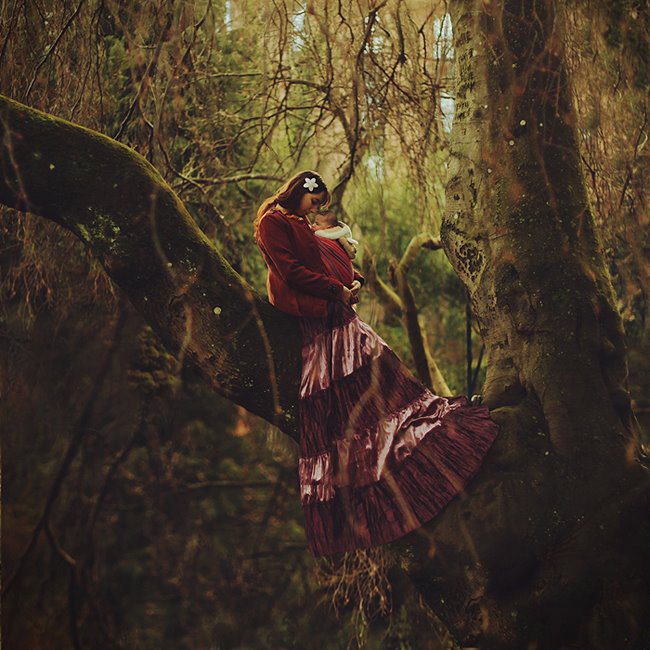
Photo by Brooke Shaden.
In this painting, we almost see the effect, but since it’s not completely surrounded by darks we can pass it off for aerial perspective and not a window of depth. Yes, think window, door, tunnel…all of these create this effect.
Painting by Elizabeth Jane Gardner.Photo by Emily Soto.
Another example of a great photo, but not quite the technique we’re looking for.
Painting by George Frederick Watts.
Same with this one.
Just Right
Well, we’ve seen the “not quite” examples, now let’s take a look at some good one’s!
This one is certainly living up to the whole “window of depth” catch phrase since it happens to be a window. Don’t let that fool you though, I almost didn’t add this to the great examples category. But since he was able to capture the elements beyond the window he adds depth. Our eyes can travel out the window, then back again. I love the classic, yet modern feel of this one too with the laptop as a prop. Is she checking her Facebook??
Photo by Alexander Bergstrom.
This one uses the same exact technique Bouguereau used in the very first example. Light area of rocks middle left, and a tunnel of light coming through the trees on the upper right.
Painting by Arantzazu Martinez.
Here we see another one. Are you getting a feel for it now? Light surrounded by dark, creating a contrasting area for the eye’s to travel through, or beyond.
Painting by Ashur Durand.
This is a fun one. He adds depth by creating a reflective surface on the table.
Painting by Quentin Massys.
Here’s a detail of it. We can see the outdoors and another person in the room. Perhaps someone wanting to borrow money.
Here we see that the door allows us to visually travel outside of the room, then back again.
Photo by Erwin Olaf.
This one also allows our eyes to travel past the woman, past the window, out to the tree line, then back again.
Painting by Caspar David Friedrich.Photo by Minolo Almeida.Painting by Frans Francken.
This one he has both a door and a window creating depth.
Painting by Frans Francken.
Another Bouguereau which adds a window of depth. See the area by the nymph on the left. He allows us to explore the area more with this little suggested tunnel of light.
Corot loved to create this effect within his paintings. As you can see he’s adding depth, allowing our eyes to travel deep into the forest.
Paintings by Corot.
Another Corot…
And another…he greatly inspired me when I first started learning about design techniques.
Here’s a few examples of the pieces that were inspired by him. They all give examples of the window of depth. But this was before I knew this was even a technique. I adopted Corot as a mentor, so I blindly tried to emulate the way he created his paintings. Sometimes you get lucky! This is why I highly recommend you find someone to adopt as a mentor…alive or dead. Learn their techniques, copy them, emulate them, and eventually something will rub off.
Photo by Tavis Leaf Glover.
Can you spot the window of depth in this one?
Photo by Tavis Leaf Glover.Photo by Tavis Leaf Glover.
This one has a hole in the wall which acts as a window to another room. We can pass through this window to the other side where another scene is formed.
Painting by Diego Velazquez.
Lucian Freud allows us to travel from his family and out of the window on the left, then back again.
Painting by Lucian Freud.
These two as well.
Painting on left by Henrietta Rae, Painting on right by George Harcourt.
And this one…
Painting by Georgos Rorris.Photo by Tavis Leaf Glover.
Another window is used to create depth.
Photo by Harry Gruyaert.
In this one, he uses the doorway on the left to add depth.
Painting by Jean-Leon Gerome.
This one, though it’s a theatre, appears to be a window to an iceberg.
Painting by Jeremy Miranda.
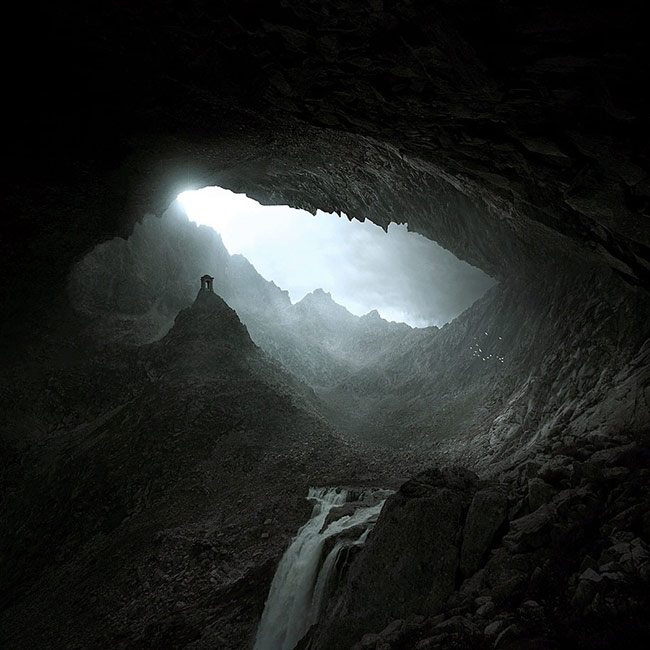
This one combines aerial perspective and the window of depth. Can you feel how deep and massive this cavern is??
Artwork by Karezoid Michal Karcz.Artwork on left by Unknown, Painting on right by Waterhouse.
Can you see how these artists are using this technique?
Painting on left by Henrietta Rae, Painting on right by Pascal Dagnan.Painting by Henrietta Rae.Painting by Dott Bunn.Painting by Rohden.
This one is fun. If you look close you can see the deer and hunter running on the were area of light.
Painting by Rubens.
This one might make you blush, but it shows us a window of depth in the upper left corner.
Painting by Rubens.Painting by Rubens.Photo by Tavis Leaf GloverPainting by Sir Lawrence Alma Tadema.
Both artists are using doors to create more depth.
Painting on left by Tintoretto, painting on right by Tadema.
This would be ideal if we could see out of the window, but since the girl is right up close to the camera our eye creates depth as it travels to the window and back.
Photo by Tom Chambers.
Here’s Van Gogh using the door to add depth.
Painting by Van Gogh.
Not your typical Van Gogh, but we can see that he adds light on the distant trees to carry our eyes there and back.
Painting by Van Gogh.
Well, by now you should have a pretty good grasp on creating a window of depth. In fact, you’re probably so excited about this technique that you’re going to go out and start capturing it! Right? Thanks for all of the support you guys, I’ll see you next time!

 Here’s the painting adjusted just by taking out that lightest area in the trees. Can you see how the depth is affected?
 How about now when I edit out the other light areas in the forest? The depth is affected dramatically. It’s still an amazing painting, but the effect of depth he achieved is no longer visible.
 In order for it to be perceived as depth it has to be higher in the frame than the subject. This tells our mind that it is receding into the distance. And if it’s a window or door, it should present hints of what lies beyond it. If it’s a forest scene, then light is sufficient




 Here we see that the door allows us to visually travel outside of the room, then back again.


 Corot loved to create this effect within his paintings. As you can see he’s adding depth, allowing our eyes to travel deep into the forest.

 And another…he greatly inspired me when I first started learning about design techniques.
 Here’s a few examples of the pieces that were inspired by him. They all give examples of the window of depth. But this was before I knew this was even a technique. I adopted Corot as a mentor, so I blindly tried to emulate the way he created his paintings. Sometimes you get lucky! This is why I highly recommend you find someone to adopt as a mentor…alive or dead. Learn their techniques, copy them, emulate them, and eventually something will rub off.